Why merchants are looking beyond Triple Whale
The best alternatives to Triple Whale for Shopify fall into three categories: deeper attribution tools like Northbeam and Cometly, profit tracking apps like TrueProfit, and broader analytics platforms like AnalysisGPT that let you ask plain-English questions across connected data sources without a data team.
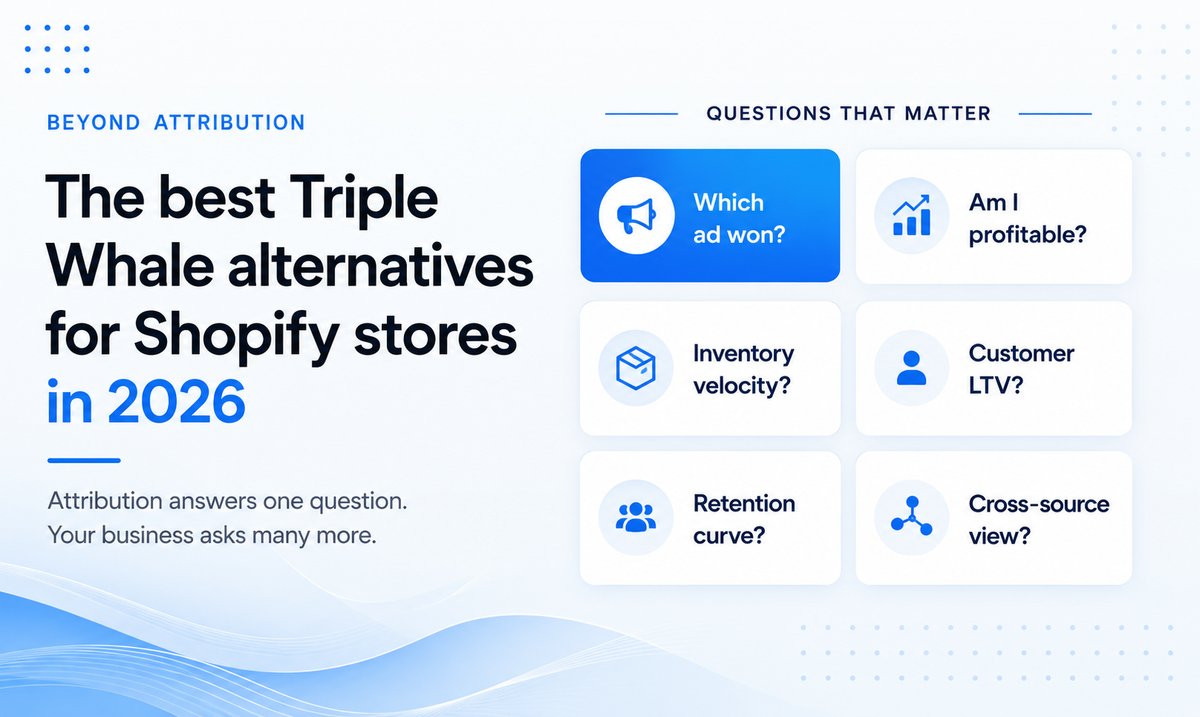
Attribution matters, but it answers only one question: which ad brought this customer? For many Shopify operators, basic purchase attribution is already expected. The harder questions involve profitability, inventory velocity, customer retention, and whether the business is making money after all costs are counted. More merchants now need answers from multiple data sources at once, and a tool focused on ad tracking leaves those questions unanswered.
Key takeaways
- Triple Whale excels at attribution but comes at a premium. Its pixel-based attribution and creative analytics are powerful, but GMV-based pricing and feature restrictions lead many merchants to consider alternatives.
- Most alternatives solve attribution, not broader analytics. Many competing tools focus on replacing attribution models, while fewer help answer questions about profitability, inventory, and overall business performance.
- Affordable options exist for specific use cases. ThoughtMetric offers one of the lowest-cost attribution-focused solutions, while TrueProfit provides accessible profit tracking for Shopify merchants.
- Different attribution tools serve different needs. Northbeam specializes in media mix modeling (MMM), Cometly focuses on server-side tracking, and Hyros is designed for businesses with longer, higher-ticket sales cycles.
- Analytics and attribution are not the same thing. Attribution tools help assign channel credit, profit tools reveal margin performance, retention tools measure LTV and cohorts, and analytics platforms answer questions that span multiple systems and data sources.
The next section gives Triple Whale fair credit before walking through the specific friction points that push merchants to explore other options.
What Triple Whale does well (and where it falls short)
Triple Whale deserves credit for making attribution accessible to Shopify merchants who previously relied on guesswork or basic UTM tracking. Its pixel-based attribution gives direct-to-consumer (DTC) brands a clearer picture of which ads drive purchases, and its creative analytics help teams identify top-performing ad variations. For brands spending heavily on paid social, that combination can be enough to guide campaign and creative decisions.
The friction starts with pricing. Triple Whale's pricing is tied to GMV tiers. At the lowest public GMV tier, current pricing shows Free at $0, Starter at $179/month, Advanced at $259/month, and Custom from $539/month, with prices based on a 12-month commitment. As GMV rises, the same merchant can move into a higher price band even if the team's day-to-day attribution workflow has not changed.
Feature access adds to the frustration. Several broader analytics capabilities, including product analytics, cohort analysis, inventory and profitability analysis, dashboard building, segmentation, and SQL access, appear on higher tiers rather than the free or Starter plans. For a bootstrapped brand doing $1M in revenue, paying $259/month or more for the full toolset is hard to justify.
Complexity is the third issue. Triple Whale offers multiple attribution models, custom reporting, and deep integrations. For a founder who also handles ops, finance, and customer service, most of that functionality goes unused.
Triple Whale has expanded beyond basic attribution, especially on higher tiers that include product analytics, cohort analysis, and inventory and profitability analysis. The issue for many small merchants is that those broader capabilities live inside a GMV-priced marketing analytics platform with tiered access. If your main need is simple profit visibility, retention analysis, or plain-English answers across systems, a more focused tool may be easier and cheaper to justify.
Attribution numbers often differ across Triple Whale, Meta, Shopify, and Google Analytics 4 (GA4) because each platform uses different windows, models, and data collection methods. The question is not which number is universally correct, but which system gives you a decision rule you trust.
How we evaluated these alternatives
We evaluated each alternative across five criteria that matter most to Shopify merchants making this decision.
Breadth of analytics measures whether a tool goes beyond attribution. Some merchants need multi-touch tracking. Others need profitability calculations, cohort analysis, or cross-system queries. Tools that answer more than one type of question scored higher.
Pricing transparency reflects how easy it is to understand what you will pay. Sales-led pricing with no public numbers scored lower than published, self-serve pricing. GMV-based models received additional scrutiny.
Shopify integration depth evaluates how well each tool connects with Shopify's data. A native app that pulls orders, customers, and product data automatically is more useful than one requiring manual exports.
Ease of use for non-technical users considers whether a founder or ops lead can get value without SQL knowledge, dashboard-building skills, or a data team. Tools that require significant technical configuration scored lower.
Data methodology and reconciliation considers whether the tool explains how it collects, models, and reconciles data, especially when platform-reported numbers disagree. Tools with documented approaches scored higher.
At-a-glance comparison
The eight tools below span four categories with significant pricing and capability differences, from $35/mo profit tracking to enterprise-level media mix modeling.
Not every tool below is a one-for-one Triple Whale replacement. Some replace attribution, while others solve the adjacent problem that often causes merchants to question Triple Whale in the first place: profit visibility, retention, or broader business analytics.
The 8 best Triple Whale alternatives in 2026
Disclosure: AnalysisGPT is our platform. We've placed it first on this list because it addresses a gap the other tools don't: broader business analytics beyond attribution. The remaining tools are assessed using public product documentation, current pricing pages, and category relevance.
1. AnalysisGPT
Who it works for: Shopify merchants and SMB operators who need answers from connected business data, not just ad pixels.
Best for analyzing: Cross-source business analytics in plain English without a data team.
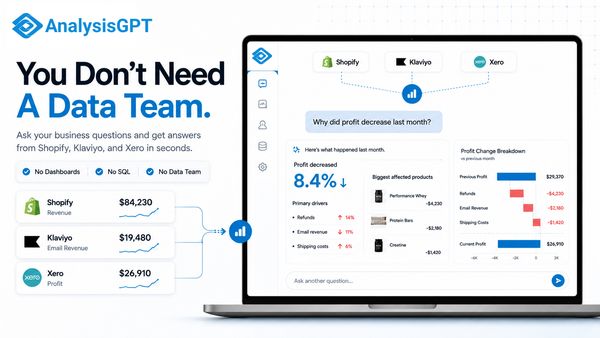
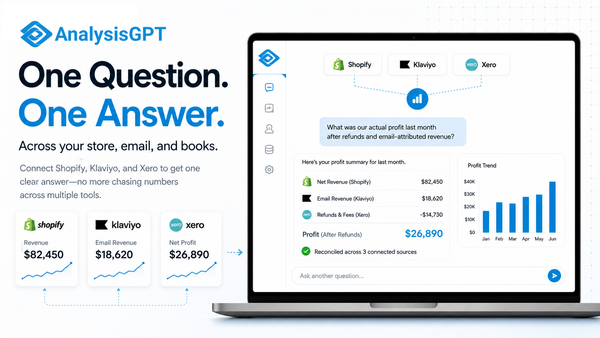
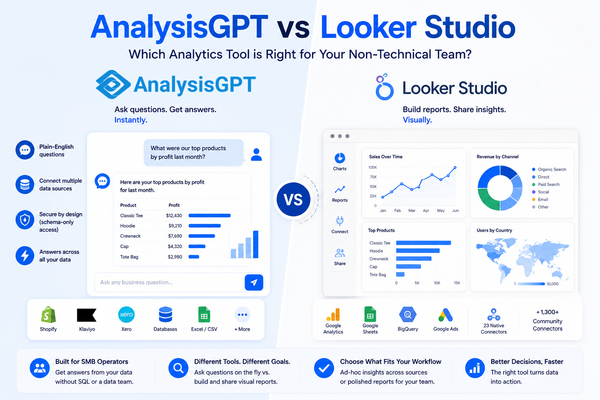
Why it belongs on this list: Most Triple Whale alternatives replace one attribution tool with another. AnalysisGPT is a different kind of alternative: a conversational analytics platform that connects to supported business data sources including Shopify, databases, and Excel or CSV files, then lets you ask business questions in plain English.
The main business question it answers: "What is happening across my business right now?"
Key features and functions:
- Natural language queries: Ask "What were my top 10 products by margin last quarter?" and get answers without SQL
- Shopify native connector: Live integration launched 2026-03-23
- Multiple data sources: Database connections plus Excel and CSV upload
- Data security by design: The large language model (LLM) sees only column fields and table metadata, the LLM formats the query, read-only access executes the query, and user data stays in the customer's systems
- Compliance: AnalysisGPT is SOC 2 Type II, ISO 27001, ISO 42001, and GDPR compliant
Choose this if: You need answers that span multiple data sources and want to ask questions in plain English without building dashboards.
Skip this if: You need deep multi-touch attribution modeling or media mix analysis for high-spend ad accounts.
Pricing: Trial at £0, Excel at £20 billed every 30 days, Pro at £90 billed every 30 days, Enterprise custom.
2. Northbeam
Who it works for: High-spend DTC and e-commerce brands running complex, multi-channel ad campaigns.
Best for analyzing: Incrementality measurement and media mix modeling for high-volume, multi-channel campaigns.
Why it belongs on this list: Northbeam combines multi-touch attribution with media mix modeling, giving brands a statistical view of which channels truly drive incremental revenue. Northbeam positions itself for high-scale marketing measurement, with vendor-stated figures including $25B in ad spend tracked and $130B in ad-attributed revenue.
The main business question it answers: "Which of my ad channels is driving incremental revenue?"
Key features and functions:
- Multi-touch attribution plus MMM: Combines click-level tracking with statistical modeling for a more complete picture
- Incrementality testing: Measures whether turning off a channel changes outcomes
- Scale: Northbeam states it tracks $25B in ad spend and $130B in ad-attributed revenue
- Creative analytics: Performance breakdowns by creative asset and variation
- Cross-channel view: Unified reporting across Meta, Google, TikTok, and other channels
Choose this if: You spend heavily on paid media across multiple channels and need statistical confidence in channel allocation.
Skip this if: You are a smaller brand looking for affordable, self-serve analytics.
Pricing: Custom, sales-led. Expect enterprise-level costs based on ad spend volume.
3. Cometly
Who it works for: Teams that want server-side attribution data pushed back into ad platform algorithms for better targeting.
Best for analyzing: Server-side tracking, Conversion API sync, and ad-platform optimization. Merchants should verify current ecommerce fit because Cometly's public pricing page is heavily B2B SaaS-oriented.
Why it belongs on this list: Cometly takes a different approach to attribution by combining server-side tracking, Conversion API, and ad-platform connections. Teams can send cleaner conversion signals back to platforms like Meta and Google rather than only reporting on performance after the fact. Merchants should verify current ecommerce fit because Cometly's public pricing page is heavily B2B SaaS-oriented.
The main business question it answers: "Are my ad platforms getting accurate conversion data to optimize against?"
Key features and functions:
- Server-side tracking: Captures conversions that client-side pixels miss
- Conversion API: Sends conversion signals back to ad platforms to improve targeting
- AI-powered attribution: Models the customer journey across touchpoints
- Ad platform integrations: Connects with Meta, Google, TikTok, Snapchat, and others
- CRM and warehouse sync: Connects attribution data with downstream revenue systems
Choose this if: You want attribution that improves your ad platform algorithms, not just reports on them.
Skip this if: Your analytics needs extend beyond ad performance into profitability, inventory, or cross-system reporting.
Pricing: Custom, sales-led. Core and Enterprise plans; no free trial, Core includes a 60-day opt-out. Pricing is quoted after sizing sessions and ad spend.
4. Hyros
Who it works for: Businesses selling high-ticket products, info products, or services with long sales cycles and phone-based closing.
Best for analyzing: Attribution across extended conversion windows and offline sales channels.
Why it belongs on this list: Hyros specializes in attribution where the customer journey stretches over weeks or months and often includes phone calls or application funnels. Standard pixel-based attribution loses accuracy when the gap between first click and purchase exceeds 28 days. Hyros claims customers see a 15%+ average increase in ad ROI.
The main business question it answers: "Which ads are driving my high-ticket sales when the buying cycle takes weeks?"
Key features and functions:
- Long attribution windows: Tracks journeys that span weeks or months beyond standard pixel windows
- Call tracking: Attributes phone sales back to the original ad click
- AI-based modeling: Follows users across devices and sessions
- High-ticket focus: Built for products priced at hundreds or thousands of dollars
- Application funnel tracking: Connects ad clicks to multi-step sales processes
Choose this if: You sell high-ticket products where the sales cycle involves phone calls, applications, or conversion windows longer than 30 days.
Skip this if: You run a standard Shopify DTC store with typical online checkout flows.
Pricing: Custom, sales-led. Positioning suggests it targets businesses with significant ad spend.
5. ThoughtMetric
Who it works for: Growing Shopify brands that want multi-touch attribution without enterprise pricing.
Best for analyzing: Affordable attribution with full feature access at every tier.
Why it belongs on this list: ThoughtMetric includes all features at every pricing tier. Starting at $99 per month with pricing based on monthly pageviews, it offers five attribution models and supports Shopify, WooCommerce, BigCommerce, and Magento. For brands priced out of tools like Triple Whale or Northbeam, ThoughtMetric provides a clear alternative.
The main business question it answers: "Which marketing channels deserve more budget based on actual purchase attribution?"
Key features and functions:
- Five attribution models: First click, last click, linear, position-based, and data-driven options
- No feature gating: Every plan includes every feature. Pricing scales with pageviews, not locked capabilities
- Multi-platform support: Works with Shopify, WooCommerce, BigCommerce, and Magento
- Customer journey mapping: Visual path from first touch to conversion
- Survey attribution: Post-purchase surveys to supplement pixel-based tracking
Choose this if: You want solid multi-touch attribution at a predictable price without features locked behind higher tiers.
Skip this if: You need media mix modeling, incrementality testing, or analytics beyond attribution.
Pricing: Starts at $99 per month, with pricing based on monthly pageviews. All features included at every tier.
6. TrueProfit
Who it works for: Shopify merchants who need to know whether they are making money after all costs are counted.
Best for analyzing: Real-time net profit tracking at the order, product, and store level.
Why it belongs on this list: TrueProfit answers a fundamentally different question than attribution tools: whether each order was profitable after shipping, transaction fees, cost of goods sold (COGS), and returns. With over 750 Shopify reviews, TrueProfit is one of the most reviewed profit tracking apps in the Shopify App Store.
The main business question it answers: "Am I making money on this product, order, or campaign after all costs?"
Key features and functions:
- Real-time profit dashboard: Net profit updated as orders come in
- True cost tracking: Accounts for COGS, shipping, transaction fees, returns, and discounts
- Product-level profitability: See which SKUs make money and which lose it
- Native Shopify app: Installs from the Shopify App Store with minimal configuration
- Marketing attribution: Available on higher tiers, including Ultimate at $100/month and Enterprise at $200 per month
Choose this if: Your biggest blind spot is profitability, and you want real margins at the order and product level without spreadsheets.
Skip this if: Your primary need is ad attribution. TrueProfit's attribution features are on higher tiers, so it is better treated as a profit tracker first.
Pricing: Basic plan at $35 per month for up to 300 orders, then $0.30 per extra order. Marketing Attribution appears on higher tiers, including Ultimate at $100/month and Enterprise at $200/month.
7. Polar Analytics
Who it works for: Mid-market Shopify brands that want a centralized data layer and reporting platform, not just an attribution pixel.
Best for analyzing: Centralized BI and reporting with a dedicated data infrastructure.
Why it belongs on this list: Polar Analytics goes deeper than attribution by pulling data from multiple sources into a dedicated Snowflake database. Brands get a first-party pixel for tracking plus centralized reporting across channels, products, and customer segments. With over 4,000 brands on the platform, Polar has established itself as a mid-market alternative to building a custom data stack.
The main business question it answers: "How do I get all my e-commerce data into one place without building a data warehouse?"
Key features and functions:
- Dedicated Snowflake database: Each customer gets their own data warehouse, not just dashboards
- First-party pixel: Server-side tracking that reduces data loss from browser privacy changes
- Multi-source integrations: Pulls from Shopify, ad platforms, email tools, and more
- Pre-built and custom reports: Templates for common e-commerce KPIs plus custom reporting
Choose this if: You want a centralized ecommerce data platform with a dedicated Snowflake database.
Skip this if: You are a smaller brand. Polar's pricing is GMV-tiered and not a flat starting price, which prices out many early-stage merchants.
Pricing: GMV-tiered; Core and Custom plans available. The pricing page uses a GMV selector. Verify current pricing with Polar directly.
8. Peel Insights
Who it works for: DTC brands that want to understand which customers are worth acquiring, not just which ads brought them.
Best for analyzing: Cohort analysis, retention analytics, and lifetime value tracking.
Why it belongs on this list: Peel Insights focuses on what happens after the first purchase. Its cohort analysis and LTV tracking help brands understand repeat purchase patterns, retention curves, and which acquisition channels produce the highest long-term value. Knowing that customers from one channel have 3x the LTV of another changes the budget conversation entirely.
The main business question it answers: "Which customer segments are most valuable over time, and where should I invest to get more of them?"
Key features and functions:
- Cohort analysis: Track customer behavior grouped by acquisition date, channel, or product
- LTV calculations: Lifetime value broken down by segment, product, and acquisition source
- Retention analytics: Repeat purchase rates, time between orders, and churn indicators
- Multi-platform data: Connects with Shopify, Amazon, GA4, Klaviyo, and subscription platforms
Choose this if: You have a repeat-purchase business and want to optimize for lifetime value over first-order acquisition.
Skip this if: You are an early-stage store without enough repeat-purchase volume to make cohort analysis meaningful, or your primary need is real-time attribution. Peel's own pricing page is oriented toward stores with significant monthly order volume.
Pricing: Essentials plan at $449 per month when billed annually, or $499 per month on a monthly basis.
How to choose the right Triple Whale alternative
The right tool depends on the question you are trying to answer. Attribution tools tell you which ads work. Profit tools tell you whether you are making money. Analytics platforms help you understand what is happening across your entire business. Picking the wrong category means the tool will always feel like it is missing something.
Start by identifying your primary gap. If Triple Whale's attribution was useful but you need more depth, look at Northbeam, Cometly, or ThoughtMetric. If attribution is fine but you have no visibility into real margins, TrueProfit fills that gap. If your problem is bigger than any single category, where you need to pull data from Shopify, your accounting software, and spreadsheets into one place, that is where broader analytics tools fit.
Budget matters, but cost per insight matters more. A lower-cost tool that answers your specific question is worth more than a premium platform whose reports no one reads.
The table below maps common needs to a starting point.
Frequently asked questions
Is Triple Whale worth it in 2026?
Triple Whale remains a solid attribution tool for Shopify brands that primarily need pixel-based ad tracking and creative analytics. Where it becomes harder to justify is when your needs extend beyond attribution into profitability, cross-source reporting, or broader business analytics. If you are paying for gated features you do not use, the value equation shifts.
Do I need attribution or analytics?
Attribution tells you which marketing touchpoint deserves credit for a sale. Analytics is broader, covering profitability, inventory, customer behavior, and operational questions. Most Shopify merchants need some attribution, but many discover their bigger gap is understanding overall business performance across multiple data sources.
What is the cheapest Triple Whale alternative?
TrueProfit starts at $35 per month for profit tracking, and ThoughtMetric starts at $99 per month for multi-touch attribution. AnalysisGPT offers a free trial and an Excel plan at £20 billed every 30 days for file-based analytics. The cheapest option depends on which category of tool you need.
Can I use multiple tools together, and where does GA4 fit?
Yes, and many merchants do. A common combination is an attribution tool like ThoughtMetric or Cometly paired with a profit tracker like TrueProfit. GA4 is free and provides useful traffic and conversion data, but it uses a different attribution methodology and does not offer pixel-based, Shopify-native tracking. Most merchants use GA4 as a baseline alongside a more specialized tool rather than choosing one over the other.
Which tool is best for small Shopify stores?
Focus on the specific question you need answered. For attribution on a budget, ThoughtMetric at $99 per month includes all features without tier gating. For profit tracking, TrueProfit at $35 per month is the most affordable option. For broader analytics starting from files, AnalysisGPT's Excel plan at £20 billed every 30 days offers a low entry point.
Triple Whale vs Northbeam: which is better?
Triple Whale is usually the more accessible Shopify-first option for DTC brands that need attribution dashboards and creative analytics. Northbeam is better suited to higher-spend brands that want multi-touch attribution, media mix modeling, and incrementality measurement. If your main problem is profitable channel allocation across high ad spend, evaluate Northbeam. If your main problem is affordable Shopify attribution, ThoughtMetric or Triple Whale may be easier to justify.
Which attribution tool is best for ecommerce in 2026?
No single attribution tool fits every ecommerce business. ThoughtMetric is the budget-friendly multi-touch option, Triple Whale remains strong for Shopify-first DTC attribution, Northbeam fits higher-spend brands that need media mix modeling and incrementality, Cometly fits teams that need server-side attribution and ad-platform data sync, and Hyros fits long sales cycles or call-based funnels.
How long does setup take for these tools?
Setup time varies. Native Shopify apps like TrueProfit can be running within minutes. Attribution tools like Northbeam or Cometly typically require pixel installation and a calibration period of one to two weeks before data is reliable. Database-connected tools may take longer depending on your data infrastructure.
Finding the right fit
Triple Whale built a category, but the category has grown beyond what any single attribution tool covers. The right alternative depends on whether your gap is in attribution depth, profitability visibility, retention understanding, or the ability to ask broader business questions across all your data. The merchants who get the most from their analytics stack pick tools based on the questions they need answered, not the features listed on a pricing page.
Try AnalysisGPT free. Upload an Excel file and ask your first question in minutes.