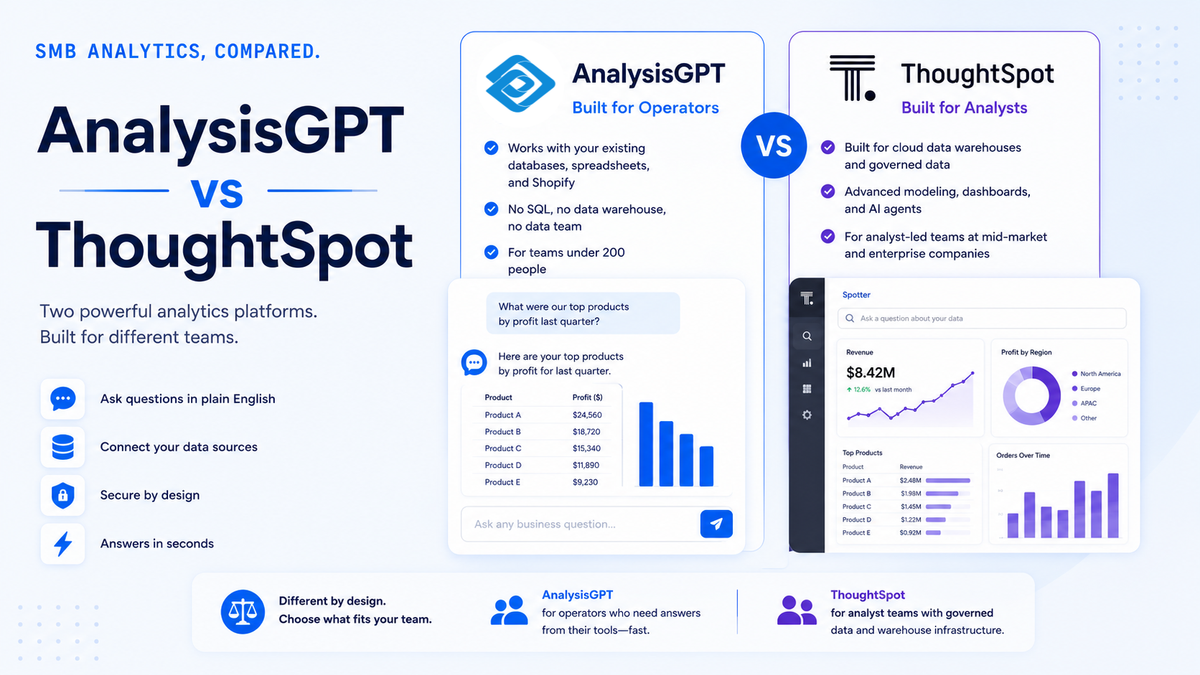
Small and mid-sized businesses looking for analytics tools face a real choice. ThoughtSpot is built to query cloud data warehouses such as Snowflake, Databricks, and Redshift. AnalysisGPT connects directly to the databases, spreadsheets, and business apps that SMB operators already use. AnalysisGPT answers questions from a live Shopify store, a connected database, or an uploaded spreadsheet. ThoughtSpot is strongest when those answers come from governed datasets and enterprise data source that a data team has already modeled and maintained. AnalysisGPT is built for operators at sub-200 person companies who lack a dedicated data team. ThoughtSpot serves analyst-led organizations with governed data stacks and warehouse infrastructure. The guide below compares the two across pricing, data architecture, AI capabilities, and audience fit so you can pick the one that matches your setup.
Key takeaways
- Target audience: AnalysisGPT serves operators at sub-200 person companies who lack a data team. ThoughtSpot serves analyst-led organizations with existing cloud data warehouses.
- Pricing: ThoughtSpot Essentials starts at $25 per user per month, billed annually. AnalysisGPT plans start at £0 for a trial, with paid plans at £20 and £90, billed roughly monthly.
- Data architecture: ThoughtSpot connects to Snowflake, Databricks, BigQuery, Redshift, and PostgreSQL. AnalysisGPT connects to databases, Excel/CSV files, and Shopify without requiring a data warehouse.
- AI capabilities: AnalysisGPT supports querying across multiple connected data sources in a single conversation. ThoughtSpot's Spotter agent platform includes data-modeling, dashboard, and coding agents, but these require Pro or Enterprise tiers.
At-a-glance comparison table
AnalysisGPT connects to live SMB tools and answers questions without a warehouse or data team. ThoughtSpot is strongest when a team already has governed data infrastructure, modeled datasets, and analyst support. The table below covers use case, target user, data connections, security architecture, and pricing to show where AnalysisGPT and ThoughtSpot diverge.
What is AnalysisGPT?
AnalysisGPT is a conversational analytics platform that lets non-technical operators connect databases, upload Excel or CSV files, or link a Shopify store and ask business questions in plain English. The platform generates and executes queries without requiring SQL, ETL pipelines, or a dedicated data team. It is designed for companies with fewer than 200 people where no one's job title includes "data analyst."
- Direct connections to existing tools: Connect a database, upload a spreadsheet, or pull live Shopify data, then ask questions that span multiple sources in a single conversation. Compare Shopify revenue against inventory in a connected database or match ad spend in a CSV to sales records without combining them manually or building a pipeline first. Additional integrations including QuickBooks and Square are on the roadmap.
- Schema-only security architecture: The AI model sees your schema only, not the underlying records. A separate read-only connection executes queries against your systems, so customer data stays where it already lives. AnalysisGPT holds SOC 2, ISO 27001, ISO 42001, and GDPR compliance certifications.
- Flat pricing with no per-user fees: Pricing starts at £0 for a time-limited trial, with the Excel plan at £20 and the Pro plan at £90, all billed roughly monthly.
What is ThoughtSpot?
ThoughtSpot is an enterprise agentic analytics platform that layers AI agents on top of governed cloud data warehouses. Enterprise customers including Anthem, Comcast, PNC, CVS, and HP use the platform across their analytics operations. The product is strongest when an organization already has a data warehouse, a modeling layer, and analyst staff to maintain both. For those teams, ThoughtSpot adds a conversational and agentic query layer on top of infrastructure they have already built.
- Agentic AI layer: Spotter is a team of AI agents that handles conversational queries, data modeling, dashboard generation, and coding tasks. Spotter is powered by ThoughtSpot's patented search token architecture and supports multiple large language models (LLMs) including GPT-series models, Google Gemini, Snowflake Cortex, and Claude.
- Warehouse and workflow connections: Analyst Studio connects to Snowflake, Databricks, BigQuery, Redshift, and PostgreSQL, and supports SQL, Python, R, and spreadsheet workflows natively. The platform also offers embedded analytics through its Visual Embed SDK (software development kit), platform APIs, and an MCP (Model Context Protocol) server. The platform has over 300 reviews on G2.
- Enterprise pricing: Pricing follows an enterprise model with custom contracts for larger deployments. Essentials starts at $25 per user per month, billed annually. Pro uses usage-based pricing starting at $0.10 per query.
How AnalysisGPT and ThoughtSpot compare
AnalysisGPT and ThoughtSpot answer business questions in plain English from different infrastructure starting points. AnalysisGPT connects to operational SMB tools directly. ThoughtSpot sits on top of a governed cloud data warehouse. If you have a Shopify store, databases, and spreadsheets but no data warehouse, AnalysisGPT is the direct path to answers.
Target audience and setup
AnalysisGPT targets operators, founders, and finance managers at companies with fewer than 200 people who need answers from their data without hiring analysts. ThoughtSpot targets organizations with dedicated data engineers, governed warehouse infrastructure, and analysts who model and permission data for the rest of the company. Setup reflects this split: AnalysisGPT requires connecting a data source and asking a question; ThoughtSpot is strongest when a team already has modeled datasets in a cloud warehouse.
AnalysisGPT:
- Built for: Operators, founders, ops leads, and finance managers at sub-200 person companies who need answers without writing SQL.
- Setup: No data team required. Connect your existing tools and start asking questions in plain English.
ThoughtSpot:
- Built for: Enterprise analytics teams with dedicated data engineers and analysts who maintain a cloud data warehouse.
- Setup: Strongest with a governed data warehouse (Snowflake, Databricks, BigQuery, Redshift, or PostgreSQL) and modeled datasets already in place.
AnalysisGPT is a strong fit for teams that need answers without building a data stack first. ThoughtSpot is a strong fit for organizations that already have one.
Data connections
AnalysisGPT connects to databases via direct credentials, accepts Excel and CSV uploads, and has a native Shopify connector that went live in March 2026. ThoughtSpot's Analyst Studio connects to Snowflake, Databricks, BigQuery, Redshift, and PostgreSQL, and supports SQL, Python, R, and spreadsheet workflows for data preparation. AnalysisGPT connects to live operational tools like Shopify and databases directly; ThoughtSpot connects to data warehouses where a team has already modeled and staged the data.
AnalysisGPT:
- Connects to: Databases (via direct credentials), Excel and CSV uploads, and a native Shopify connector.
- Coming soon: Additional integrations including QuickBooks and Square are on the roadmap.
- Architecture: No ETL pipeline, no warehouse setup. You connect a source and start asking questions.
ThoughtSpot:
- Connects to: Snowflake, Databricks, BigQuery, Redshift, PostgreSQL, Excel, Google Sheets, JSON, and SaaS apps via Analyst Studio.
- Essentials tier: Supports five to 50 users and up to 25 million rows.
- Pro tier: Supports 25 to 1,000 users and up to 250 million rows.
AnalysisGPT connects directly to the tools SMBs already use and runs queries from there. ThoughtSpot connects to a broader set of enterprise data sources through Analyst Studio, and is designed for teams with a cloud data warehouse already in place.
AI approach
AnalysisGPT uses a conversational model that generates and executes queries across connected sources in a single workflow, with the AI seeing only schema metadata while a separate read-only connection runs the actual query. ThoughtSpot takes an agentic approach. Spotter includes four named agents: Spotter, SpotterModel, SpotterViz, and SpotterCode. They handle conversational queries, data modeling, dashboard generation, and coding tasks on top of governed warehouse data.
AnalysisGPT:
- Model: Conversational analytics. You ask a business question in plain English, and the platform writes and executes the query for you.
- Cross-source analysis: Pulls answers from multiple connected sources in the same workflow.
- Data privacy: The AI model sees your schema only. It writes the query; a separate read-only connection runs it against your system.
ThoughtSpot:
- Model: Agentic analytics. Spotter supports multiple LLMs (GPT-series, Gemini, Snowflake Cortex, Claude) and is powered by ThoughtSpot's patented search token architecture.
- Availability: AI agents require the Pro or Enterprise tier. Essentials does not include AI agents based on the current pricing page feature comparison.
AnalysisGPT focuses on conversational queries across connected operational tools. ThoughtSpot's agent-based approach targets teams with warehouse-scale data, though the AI features require higher tiers.
Pricing
AnalysisGPT charges flat GBP rates per plan with no per-user fees. The Trial is free, the Excel plan is £20, and the Pro plan is £90, all billed roughly monthly. A 10-person team pays the same as a solo operator on the same plan. ThoughtSpot Essentials starts at $25 per user per month billed annually, and Pro uses usage-based pricing at $0.10 per query. Per-user and per-query models mean ThoughtSpot costs scale with team size and usage volume. For an SMB operator, flat pricing removes the need to forecast per-seat spend as the team grows.
The at-a-glance table above includes a full tier breakdown for each product. AnalysisGPT uses flat, predictable pricing in GBP with no per-user charges on standard plans. ThoughtSpot uses per-user and usage-based pricing in USD, which scales with team size and query volume. For a 10-person team on ThoughtSpot Essentials, the annual commitment would start at $3,000 before any usage-based charges on higher tiers.
When to choose AnalysisGPT
AnalysisGPT suits operators at sub-200 person companies who need answers from Shopify, databases, and spreadsheets without a data warehouse or analyst on staff. The person asking the question is typically the same person acting on the answer, and the platform is built around that workflow. If your data already lives in operational tools and you want answers without building infrastructure first, AnalysisGPT is the direct path.
- No data team: You don't have analysts or engineers on staff, and you shouldn't need them to understand your own numbers. AnalysisGPT lets you ask business questions in plain English without writing SQL.
- Multiple data sources: Your data lives across Shopify, databases, and Excel files. AnalysisGPT connects to those sources directly and answers questions that span all of them.
- Plain-English analysis: You want to type "What were my top 10 products last quarter?" and get an answer, not a dashboard you have to build yourself.
- Budget-conscious: Pricing starts at £0 for a trial and £20 for the Excel plan, billed roughly monthly. No per-user fees mean a growing team does not face escalating costs as more people ask questions.
When to choose ThoughtSpot
ThoughtSpot suits organizations with governed warehouse infrastructure, modeled datasets, and dedicated analysts already in place. The platform scales self-service analytics across dozens or hundreds of users on top of warehouse-scale data, and is a strong fit for teams that already have Snowflake, Databricks, or BigQuery in production and need a query layer their analysts and business users can share.
- Governed data warehouse in place: ThoughtSpot connects to Snowflake, Databricks, BigQuery, Redshift, and PostgreSQL. Organizations that have already invested in a warehouse and modeling layer can put ThoughtSpot on top of it.
- Embedded analytics: ThoughtSpot offers embedded analytics through its Visual Embed SDK and platform APIs, so product and engineering teams can surface analytics inside their own applications.
- Dedicated analytics team: ThoughtSpot is an enterprise agentic analytics platform designed for organizations with analysts who can model data, manage permissions, and build Liveboards for the rest of the company. The platform's AI agents layer on top of that analyst-maintained foundation.
- Large-scale data: ThoughtSpot Pro supports 25 to 1,000 users and up to 250 million rows. Organizations handling data at that volume need a platform engineered for warehouse-scale queries across large, governed datasets.
Frequently asked questions
AnalysisGPT and ThoughtSpot differ most on data architecture, pricing model, and target team size. AnalysisGPT connects to databases, spreadsheets, and Shopify directly and charges flat GBP rates with no per-user fees. ThoughtSpot is built for organizations with governed warehouse infrastructure and uses per-user or usage-based pricing in USD.
Can ThoughtSpot connect to Shopify?
ThoughtSpot's documented data connections through Analyst Studio include Snowflake, Databricks, BigQuery, Redshift, PostgreSQL, Excel, Google Sheets, and JSON, plus custom API calls for SaaS apps. Based on documented connections, accessing Shopify data through ThoughtSpot would likely involve loading it into a connected warehouse or using a custom SQL, Python, or R workflow rather than a native connector.
Does AnalysisGPT require SQL?
No. AnalysisGPT lets users ask business questions in plain English without SQL. You type a question like "Which products had the highest return rate last month?" and AnalysisGPT generates and runs the query behind the scenes. The AI model sees your schema only; a separate read-only connection executes the query against your data.
How much does ThoughtSpot cost?
ThoughtSpot uses a tiered model across Essentials, Pro, and Enterprise. Essentials starts at $25 per user per month, billed annually, and Pro uses usage-based pricing at $0.10 per query. Enterprise tiers carry custom pricing. Per-user and per-query models mean costs scale with team size and usage volume.
Is AnalysisGPT secure?
AnalysisGPT separates the AI model from your data. The model sees your database schema only and writes the query; a separate read-only connection executes that query against your system. Your data stays in your own systems. AnalysisGPT is SOC 2, ISO 27001, ISO 42001, and GDPR compliant.
Can I use both tools together?
Yes. Some organizations use ThoughtSpot for warehouse-scale reporting across large teams and AnalysisGPT for quick, cross-source answers from operational tools like Shopify and Excel. AnalysisGPT and ThoughtSpot target different operators at different company stages and do not overlap in their core use cases. No data pipeline or integration is required between them.
Which tool is a better fit for a small team?
AnalysisGPT is designed for small and mid-sized teams that don't have a data warehouse or dedicated analysts. You connect your existing tools, ask questions in plain English, and get answers without building dashboards or writing SQL. ThoughtSpot is a stronger fit for larger organizations with warehouse infrastructure and analytics staff already in place.
Try AnalysisGPT free
AnalysisGPT plans start at £0 for a trial, with paid plans at £20 and £90 billed monthly. You connect your existing business tools, ask questions in plain English, and get answers without a data warehouse or a dedicated data team.