AnalysisGPT vs Tableau at a glance
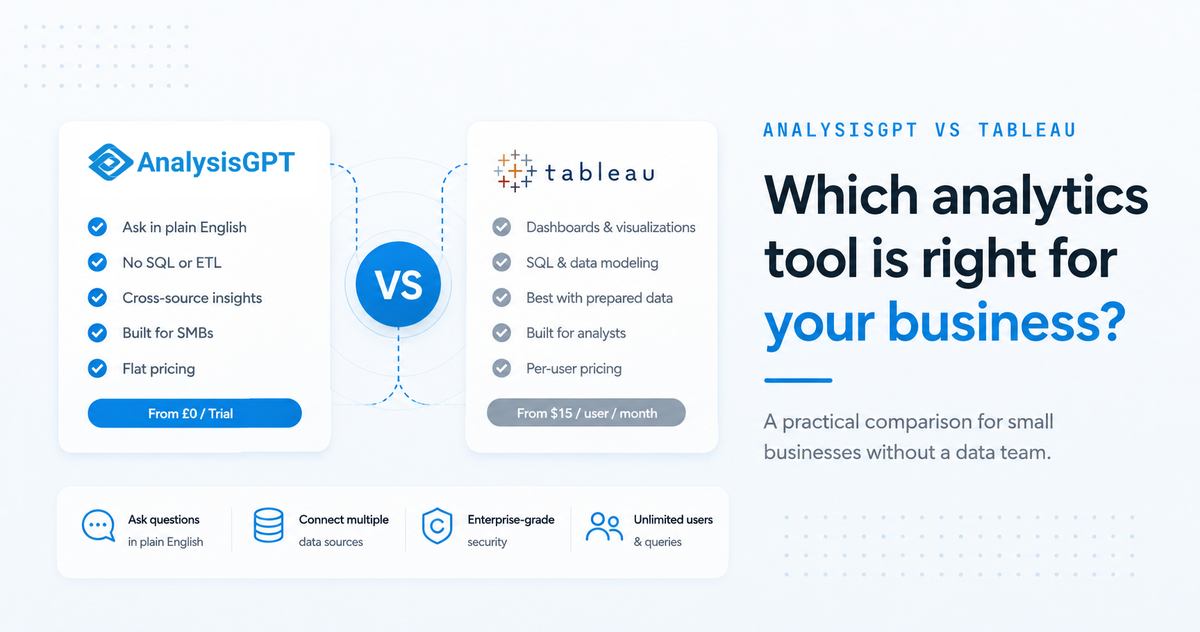
Small businesses sit on more data than ever, spread across Shopify, QuickBooks, spreadsheets, and databases. Two tools offer very different paths to making sense of it. Tableau is an enterprise BI platform built for analysts who model, prepare, and visualize data through polished dashboards. AnalysisGPT is a conversational analytics platform built for non-technical SMB operators who need answers from their business tools without writing SQL or hiring a data team. One requires preparation and expertise. The other starts with a plain-English question. The right choice depends on your team, your budget, and how you actually work with data.
Key takeaways
- AnalysisGPT lets non-technical operators ask business questions in plain English across connected data sources, with no SQL or ETL required. Teams can get answers quickly without relying on analysts or building complex data pipelines.
- Tableau excels at polished, interactive dashboards for teams that already have analysts and modeled data. It is strongest when businesses already have structured reporting workflows and dedicated data resources.
- AnalysisGPT pricing starts at £0 (Trial) and scales to £90 billed every 30 days, with unlimited team members and queries on every tier. Tableau pricing starts at $15/user/month billed annually, with costs increasing as more users are added.
- AnalysisGPT handles cross-source analysis natively. Tableau typically requires additional data prep, modeling, or a warehouse layer to combine and analyze data across multiple platforms.
At-a-glance comparison table
The table below compares both tools across nine areas that matter most to a small business without dedicated data staff. Where a feature depends on plan tier or configuration, the table reflects the most common setup.
What is AnalysisGPT
AnalysisGPT is a conversational analytics platform built for non-technical SMB operators. You connect your data sources and ask business questions in plain English. No SQL. No ETL. No data team needed.
The platform supports database connections, Excel and CSV upload, and a native Shopify integration, with QuickBooks and Square in progress. Cross-source analysis is built in. You can pull insights from multiple connected systems in a single conversation without building a data warehouse first.
Security follows a two-part architecture. The model sees only the structure of your data (the schema), not the data itself. A separate read-only connection executes queries against your systems. Customer data stays in customer systems. AnalysisGPT holds SOC 2, ISO 27001, ISO 42001, and GDPR compliance certifications.
Pricing uses flat tiers in GBP. The Trial plan costs £0. The Excel plan runs £20 billed every 30 days for teams working primarily with spreadsheet data. The Pro plan is £90 billed every 30 days and includes database connections. Every tier includes unlimited team members and unlimited queries. You pay for capability, not headcount.
What is Tableau
Tableau is an enterprise BI platform owned by Salesforce since August 2019. It turns prepared data into polished, interactive dashboards that analysts and business teams use to explore trends, spot patterns, and share findings across an organization.
The platform connects to 80+ native connectors, spanning databases, SaaS tools, and flat files. Its visualization engine is one of the strongest in the BI category. Drag-and-drop chart building, calculated fields, and a deep library of chart types give analysts fine control over how data appears. Tableau Desktop Free Edition offers local file analysis at no cost for individual users.
Governance and security are central to the platform. Tableau includes row-level security, permissions management, and audit logging. Large organizations rely on these controls to manage who sees what across departments.
Paid plans start at $15/user/month for Tableau Standard and $35/user/month for Tableau Enterprise, both billed annually. Per-user pricing means costs grow with each person who needs access. Tableau works best for organizations that already have analysts on staff and data that has been modeled and prepared. Building and maintaining dashboards requires technical skill, and getting value from the platform depends on someone doing that work consistently.
How AnalysisGPT and Tableau compare
Four dimensions separate these two platforms: who they serve, what they cost, where they pull data from, and how users interact with them.
Target user and setup
AnalysisGPT is built for non-technical operators. Founders, ops leads, and finance teams connect a data source and start asking questions in plain English within minutes. No SQL, no ETL pipelines, no dashboard-building skills required.
Tableau is an enterprise BI platform designed for analysts and data teams. A typical deployment involves data modeling, dashboard design, calculated fields, and governance configuration before anyone sees a chart. The assumption is that a trained analyst prepares the view and business users consume it.
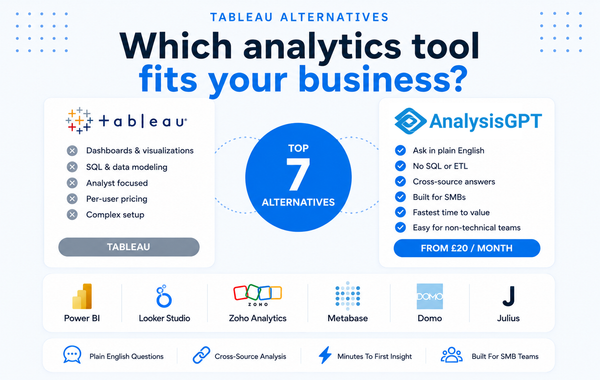
In short: AnalysisGPT is a strong fit for SMBs without dedicated analytics staff; Tableau is a strong fit for enterprises with analysts who can model data and maintain dashboards.
Pricing and cost structure
AnalysisGPT offers three paid tiers plus a free trial, all billed every 30 days:
- Trial: £0, full platform access for a limited period
- Excel: £20, file-based analysis (Excel and CSV uploads)
- Pro: £90, connected sources plus files
- Every tier includes unlimited team members and unlimited queries
Tableau's pricing follows a per-user, annual-contract model:
- Standard: from $15/user/month
- Enterprise: from $35/user/month
- Enterprise Creator: $115/user/month
- Tableau Next: from $40/user/month
Tableau also offers a Desktop Free Edition for working with local files.
A five-person team on AnalysisGPT Pro pays £90 total, billed every 30 days. The same five people on Tableau Standard pay $75/month on an annual contract. The gap widens as headcount grows because AnalysisGPT charges per workspace, not per seat.
In short: AnalysisGPT's flat pricing fits predictable SMB budgets; Tableau's per-user model scales with team size, which suits organizations that plan analytics headcount centrally.
Data connections and cross-source analysis
AnalysisGPT connects to databases via credentials and accepts Excel/CSV uploads via drag-and-drop. A native Shopify integration launched in March 2026. QuickBooks and Square integrations are in progress, and Stripe is being evaluated. Cross-source queries are built in, so users can ask questions that span multiple connected systems without any prep work.
Tableau supports 80+ native connectors to databases, cloud services, SaaS tools, and flat files. Combining data from multiple sources typically involves Tableau Prep or data modeling before the combined view appears in a dashboard.
In short: Tableau offers broader connector coverage; AnalysisGPT offers SMB-native connections (Shopify, QuickBooks, Square) and cross-source analysis without a data-preparation step.
Natural language and AI features
Plain-English queries are the primary interface in AnalysisGPT. Every user on every tier types a business question and gets an answer, a chart, or an analysis. No toggle to enable, no add-on to purchase.
Tableau's natural language capabilities are distributed across product tiers. Tableau Pulse, included in Standard plans and above, provides AI-driven metric summaries. Tableau Agent is available in the Tableau+ Bundle. Tableau Next bundles Agentforce for more advanced agentic capabilities.
In short: AnalysisGPT is a strong fit for teams that want natural language as the default experience; Tableau is a strong fit for teams that want polished dashboards first, with NL as an enhancement layer.
When to choose AnalysisGPT
AnalysisGPT is built around live business-system connections, cross-source answers, and plain-English analysis without a data team.
- You have no dedicated analyst. Operators ask questions directly and get answers in minutes, with no SQL or dashboard-building step.
- You need answers across systems. Cross-source queries combine data from databases, Shopify, and uploaded files in a single conversation.
- Your team is growing but your budget isn't. Every tier includes unlimited team members and unlimited queries, so adding people costs nothing extra.
- You run on Shopify, QuickBooks, or Square. Native Shopify is live, and QuickBooks and Square integrations are in progress.
- You want answers, not dashboards. AnalysisGPT makes more sense for operators who need answers directly.
When to choose Tableau
Tableau turns prepared data into polished dashboards. Organizations that need pixel-level control over visual output will find unmatched flexibility here.
- Your team includes a dedicated analyst or data engineer. Tableau's full power comes from data modeling, calculated fields, and curated dashboards built by someone with analytics training.
- Visualization quality is a priority. Formatting controls, layout options, and design flexibility are best-in-class. Published dashboards can match corporate brand standards down to font and color.
- You need enterprise-grade governance. Row-level security, granular permissions management, and audit logging support compliance requirements at scale.
- You connect to a wide range of data sources. 80+ native connectors cover databases, cloud storage, SaaS platforms, and flat files.
- You operate within the Salesforce ecosystem. As a Salesforce-owned platform, Tableau integrates tightly with Sales Cloud, Service Cloud, and other Salesforce products.
Frequently asked questions
How does AnalysisGPT pricing compare to Tableau?
AnalysisGPT charges a flat rate per workspace, billed every 30 days: £0 for Trial, £20 for Excel, and £90 for Pro. Every tier includes unlimited team members and queries. Tableau charges per user, starting at $15/user/month for Standard, $35/user/month for Enterprise, and $115/user/month for Enterprise Creator, on annual contracts. For small teams, AnalysisGPT's flat pricing is typically lower; Tableau's per-seat model becomes more cost-effective per user at larger team sizes with negotiated enterprise agreements.
Does AnalysisGPT work with Shopify and QuickBooks?
AnalysisGPT has a native Shopify integration that launched in March 2026. QuickBooks and Square integrations are in progress. Users can also connect databases directly and upload Excel/CSV files on any paid tier.
How do AnalysisGPT and Tableau handle data security?
AnalysisGPT uses a two-part architecture: the AI model sees only the structure of your data (the schema), not the data itself. A separate read-only connection executes queries against your systems. Tableau offers row-level security, granular permissions, and audit logging to control who sees what within shared dashboards. Both platforms support enterprise compliance requirements.
Do I need a data team to use either tool?
AnalysisGPT is designed for non-technical operators. Users connect a data source and ask questions in plain English. Tableau is built for teams with analytics staff. Getting value from Tableau typically requires someone who can model data, build dashboards, and manage governance.
Can I try both tools for free?
AnalysisGPT offers a free Trial tier with full platform access for a limited period. Tableau offers a Desktop Free Edition that works with local files. Both let you evaluate the product before committing to a paid plan.
Does Tableau have natural language features?
Yes. Tableau Pulse, available on Standard plans and above, delivers AI-driven metric summaries. Tableau Agent is part of the Tableau+ Bundle. Tableau Next includes Agentforce, which adds agentic AI capabilities to the platform. Natural language is an enhancement layer on top of Tableau's dashboard-first experience.
Try AnalysisGPT free
AnalysisGPT gives small businesses without a data team a way to connect their tools, ask plain-English questions across sources, and get trustworthy answers in minutes.
Try AnalysisGPT free. Upload an Excel file and ask your first question in minutes.