It's 9 a.m. on a Tuesday. You open your laptop to the same question you have most mornings: how is the business doing? Revenue up or down? Which products are moving? Where did last week's orders actually come from?
For most small business owners, answering those questions requires one of two options. You wait for your ops person to build a report - which might arrive Wednesday. Or you dig into the data yourself, which means twenty minutes in spreadsheets before you've read a single email.
There is a third option. It's been available for a couple of years, but most small businesses either haven't heard of it or have imagined it as something much more complicated - and expensive - than it actually is.
When Xero added AI-powered analytics to its platform in January 2026, the story wasn't about Xero getting ahead of a trend. It was confirmation that AI analytics for small businesses had stopped being experimental. When accounting software used by millions of SMBs adds an AI layer, the question shifts from "is this worth exploring?" to "what do I want mine to do?"
So what does AI analytics actually do for a business like yours? Probably less than you imagined. And more useful for it.
Key takeaways
- AI analytics for small businesses is not a robot making your decisions. It’s software that watches your numbers, flags anomalies, and answers plain-English questions about your business.
- The five most useful capabilities for a 20-person company are anomaly detection, plain-language queries, automated weekly summaries, cross-source answers, and root-cause investigation. These features help teams move faster without needing technical expertise.
- You don’t need a data team, SQL knowledge, or a six-figure budget. Most SMBs can get value from AI analytics tools that connect directly to the platforms they already use.
The version people imagine
AI analytics is almost universally misunderstood by small business owners - pictured as either a HAL 9000-style oracle making autonomous decisions or a $200,000 enterprise platform requiring a year to implement. Both pictures are wrong. The gap between the imagined version and the real one is why adoption among SMBs has been slower than it should be. AI analytics is a monitoring and question-answering layer on top of your existing data.
The version people fear is about autonomy - an AI running parts of your business without oversight. The version that actually exists is about access: getting answers to your own business questions faster than you can today.
What it actually looks like on a Tuesday morning
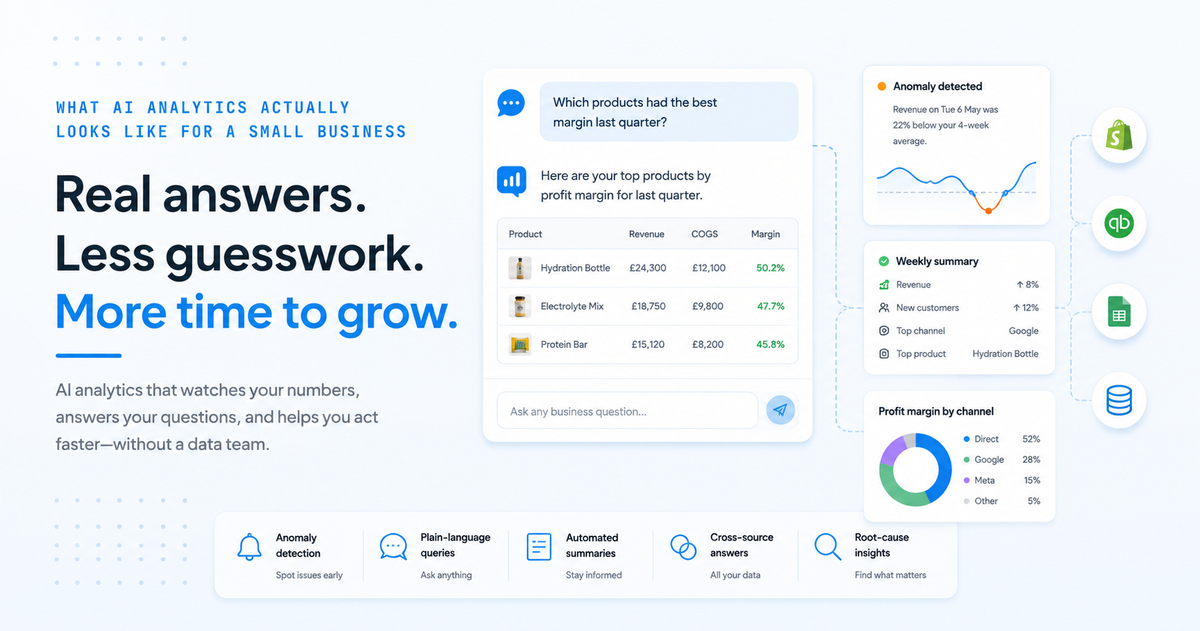
AI analytics works like a junior analyst who never sleeps - watching your numbers, flagging anything unusual, and ready to answer questions without a request form or a 24-hour wait. The five capabilities that matter most for a 20-person company are: anomaly detection, plain-language queries, automated summaries, cross-source answers, and root-cause investigation.
Here is what each one actually looks like:
Anomaly flagging
Your revenue for last Tuesday was 22% below your four-week average. Normally, nobody would notice until Friday, when your ops lead runs the weekly numbers. AI analytics flags it Tuesday afternoon - with enough time to understand what happened and potentially act. The AI doesn't tell you why. It tells you that something unusual happened. You investigate.
This is where AI analytics earns its keep for most small businesses. Not in the insight itself - in the speed.
Plain-English queries
You want to know which products had the best margin last quarter. Without an analytics tool, that means exporting from Shopify, matching against cost data in QuickBooks, and building a summary in a spreadsheet. It takes an hour and requires the one person on your team who knows how to do it.
With a conversational analytics tool, you type the question. You get an answer in seconds. No SQL required - SQL being the programming language used to query databases, and its absence being the entire point.
Automated weekly summaries
Instead of someone building the Monday morning report, the report builds itself. A weekly summary of what changed - top-performing products, which channels brought in new customers, where costs increased, how the numbers compare to last month - delivered before the first meeting of the week. The value isn't just time saved. It's that the summary exists even when your ops lead is on holiday.
Cross-source answers
You ran a summer promotion. You want to know your actual profit margin - not just revenue. That means connecting Shopify sales data with QuickBooks expense data with any advertising spend tracked separately. Manually, that's a half-day project. With AI analytics connecting multiple data sources, you ask the question and the tool pulls from both systems.
Root-cause investigation
Revenue dropped on Tuesday. You know it dropped - what you don't know is why. Was it a product? A channel? A fulfillment issue? Without an analytics tool, you'd build a series of reports to eliminate possibilities one by one. With a conversational platform, you ask "why did revenue drop last Tuesday?" and get a breakdown of contributing factors - not a verdict, but a starting point.
Why this matters more at 20 people than at 2,000
Large companies have dedicated data teams already. For a 20-person business, AI analytics doesn't improve an existing analytics infrastructure - it replaces the absence of one entirely. That difference makes the category significantly more consequential for smaller businesses, not less. A 2026 survey by Intuit found 68% of small businesses now use AI regularly, up from 48% in 2024.
Enterprise Business Intelligence (BI) software - Tableau, Power BI, Looker - was built for companies with technical teams and budgets running to six figures. Most SMBs end up in no man's land: too big for spreadsheets to keep up, too small to justify enterprise BI. AI analytics built for SMBs closes that gap directly.
The Xero launch in January 2026 is a useful market signal. Xero didn't add AI analytics because it was an early-adopter idea. It added it because small business customers expected it - or would expect it within the next product cycle. When accounting software used by tens of millions of businesses embeds an AI layer, the category has moved from experiment to standard expectation.
What AI analytics is not
AI analytics is a tool for faster, better-informed decisions - not a replacement for human judgment, not a crystal ball, not a dashboard to build. It surfaces patterns from historical data. Tools with sound security architecture keep your data in your own systems and never expose it to the model processing your queries.
Specifically:
- It's not a crystal ball. AI analytics works from your historical data. It can spot patterns and flag deviations. It can't account for market conditions, strategic decisions, or anything it hasn't seen before.
- It's not a replacement for your team. Every answer it surfaces requires a human to decide what to do. Your ops lead still exists - they just spend less time building reports.
- It's not a dashboard to build. The better SMB tools don't require you to design anything. You ask questions in plain English and get answers back.
- It's not a security risk if architected correctly. Tools that expose your actual data to the AI model create risk. A well-designed architecture separates the query layer from the data - the model sees your database structure, not your business data.
What to look for in an AI analytics tool
Five criteria are worth checking before committing to any AI analytics tool for a business under 100 people. Enterprise BI software was built for companies with technical teams and six-figure budgets - and those tools will fail the same criteria that the right tool will pass. The demo will always look good. These are the questions that reveal whether the tool is actually built for you.
The criteria:
- Connects natively to the tools you already use - QuickBooks, Shopify, HubSpot, Xero. No exports or CSV uploads required.
- Answers business questions in plain English - not SQL syntax or dashboard configuration logic.
- Sets up in hours or days, not weeks. If you need a consultant to connect your first data source, it's the wrong tool.
- Has a transparent data security architecture. Ask: does the AI model see your actual data, or only the structure of your database?
- Offers a free trial long enough to test your real questions - you need to connect your own data to know whether it works for your business.
If you're already questioning whether spreadsheets are holding your business back, here are five signs to help you decide.
Seeing it in practice
AnalysisGPT is one example of this practical, SMB-native category. It connects directly to QuickBooks and Shopify, and lets you ask business questions in plain English through a chat-like interface. No SQL. No Extract, Transform, Load (ETL) pipelines to build - ETL being the process of pulling data from one place, reformatting it, and loading it somewhere else.
On security: the LLM sees only column fields and table metadata, the LLM formats the query, read-only access executes the query, and user data stays in the customer's systems. Your actual data doesn't move.
If you want to see what your own business data looks like when it's connected and queryable, AnalysisGPT offers a 30-day free trial - enough time to connect your real data sources and ask the questions you actually have. Try AnalysisGPT free for 30 days.
For a broader look at the options available, here's a current guide to AI analytics tools built for small businesses in 2026.