
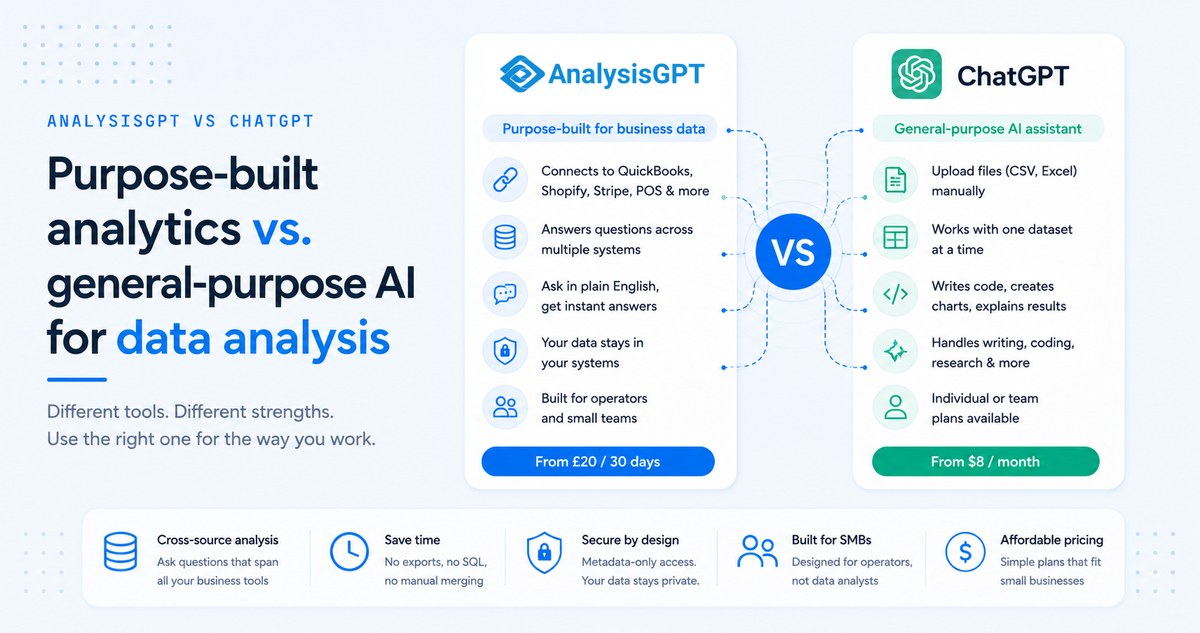
You already use ChatGPT for emails and meeting notes. Can it handle business data too - revenue by channel, margins by product line, ad spend versus sales? Both tools accept plain-language questions but are built for different users. AnalysisGPT is a purpose-built analytics platform that connects to your business tools and answers cross-system questions. ChatGPT is a general-purpose AI that analyzes files you upload manually. According to BigSur.ai, 62% of AI-adopting SMBs already use AI for data analysis - the top business application, ahead of content generation. The question isn't whether to use AI for data, but which tool fits how you work.
Key takeaways
- Purpose-built vs. general-purpose. AnalysisGPT is designed specifically for business data analysis; ChatGPT includes analysis among dozens of capabilities.
- Cross-source advantage. AnalysisGPT connects natively to QuickBooks, Shopify, and Stripe — answering questions that span systems in a single query.
- General versatility. ChatGPT handles writing, coding, research, and many other tasks alongside data work.
- The right tool depends on your data. One spreadsheet, ChatGPT works fine. Data spread across multiple systems, AnalysisGPT was built for that.
At-a-glance comparison
What is AnalysisGPT?
AnalysisGPT is a conversational analytics platform built for non-technical SMB operators and small teams. It connects natively to QuickBooks, Shopify, Stripe, POS systems, and more, so you can ask questions in plain English and get answers that pull from multiple sources at once. No SQL, no data prep, no pivot tables.
Connect your tools once, then ask questions like "How did revenue compare to ad spend by channel last quarter?" AnalysisGPT pulls data from each connected system automatically. It was built for operators who run the business, not analysts who model data for a living.
You can also upload a spreadsheet to work from a single data set. Both paths use the same conversational interface.
What is ChatGPT for data analysis?
ChatGPT is OpenAI's general-purpose AI assistant. Its data analysis feature - formerly Advanced Data Analysis or Code Interpreter - reads uploaded files, executes Python code, generates charts, and explains statistical findings.
The workflow: upload a CSV or Excel file, ask a question, and ChatGPT writes Python code behind the scenes to produce an answer. GPT-4o and GPT-5 produce strong reasoning on well-structured datasets.
ChatGPT's design wasn't built around business data workflows, so it depends on you to supply clean, ready-to-analyze files rather than pulling from your systems directly.
How AnalysisGPT and ChatGPT compare for business data analysis
Both tools accept plain-English questions. The differences show up in data access, prep work, and design intent.
Data access and cross-source analysis
Data access and cross-source analysis differ materially between the tools. AnalysisGPT connects natively to QuickBooks, Shopify, Stripe, and point-of-sale (POS) systems - cross-source queries work automatically. ChatGPT has no live connections and requires manual export, clean, and merge steps. Mordor Intelligence reports SMBs now juggle an average of nine cloud tools, and data across disconnected systems invites manual re-entry and blind spots.
- AnalysisGPT pulls from connected tools in a single query. A question like "How does ad spend compare to revenue by product category this quarter?" returns an answer with no exports or merging.
- ChatGPT needs you to export, clean, merge, and upload first. Cross-system questions require ETL knowledge or hours of spreadsheet work.
AnalysisGPT answers multi-system questions directly. ChatGPT needs you to do the integration work first.
Ease of use for non-technical users
Ease of use for non-technical users favors AnalysisGPT when you account for prep work before each question. AnalysisGPT removes the file-prep stage entirely - connected data is ready to query. ChatGPT requires users to identify, export, clean, and upload files first - the stall point for operators without data-team support.
Research from Pragmatic Institute shows 62% of data analysts depend on others to complete certain steps in the analytics process. For non-technical operators without that support, finding the right export, cleaning columns, and formatting dates is where things stall.
General AI versatility
ChatGPT does far more than data analysis. It writes marketing copy, generates code, translates documents, and adapts to nearly any knowledge task. Someone already paying for ChatGPT Plus gets dual-purpose value from the fact that it also handles data.
AnalysisGPT is purpose-built for analytics. It won't draft your investor update or debug your website. For general AI versatility with occasional data work, ChatGPT is the stronger fit.
Security and data handling
Security and data handling separate the tools on a dimension that matters for regulated data. AnalysisGPT uses a metadata-only architecture - the model receives column fields and table metadata, not raw records. ChatGPT processes uploaded files through OpenAI's infrastructure; Free and Plus plans can use content for training unless users opt out.
ChatGPT Business and Enterprise tiers exclude training at higher per-seat cost. AnalysisGPT's metadata-only approach keeps sensitive data closer to its source on every tier. Operators handling financial or customer data without a compliance team will find the metadata-only approach the better fit.
Pricing
A lower sticker price doesn't help if the tool requires hours of prep a more expensive option eliminates. The tools also use different models - per-user versus per-workspace.
AnalysisGPT pricing
AnalysisGPT offers four tiers, billed every 30 days. Every tier includes unlimited team members - pricing is per workspace, not per seat.
- Trial Plan - £0: Full platform access including real-time dashboards, unlimited queries, and predictive analytics.
- Excel Plan - £20 per 30 days: Full access for Excel and CSV-based analysis with unlimited queries and team members.
- Pro Plan - £90 per 30 days: Adds database connections alongside Excel and CSV support.
- Enterprise Plan - Contact sales: Private cloud or on-premise, advanced role-based access, and unlimited custom AI agents.
Note: Pricing in GBP (£). Visit analysisgpt.ai for current pricing in your region.
ChatGPT pricing for data analysis
ChatGPT's pricing is per user, per month, with data analysis bundled into broader AI capabilities.
- Free - $0/month: File uploads and basic analysis; message caps vary and conversations can be used for training. May include ads.
- Go - $8/month: More volume than Free, no advanced reasoning models. Includes ads.
- Plus - $20/month: The most relevant tier for data analysis. GPT-5 access, GPT-4o, Advanced Data Analysis, custom GPTs, shared projects. Content used for training unless you opt out.
- Business - $25/user/month (annual) or $30/user/month (monthly): Admin controls, SAML SSO, 60+ app integrations, SOC 2 compliance. No training on content.
- Enterprise - Contact sales: Private hosting, audit logs, SLA guarantees.
ChatGPT Plus bundles analysis with writing and research at $20/month per user. AnalysisGPT's per-workspace model changes team math: the Excel plan at £20 per 30 days covers unlimited members, so a five-person team pays the same as one.
When to choose AnalysisGPT
AnalysisGPT fits when you need fast answers from data that lives across multiple business systems - without building a pipeline first.
- Your data lives in multiple systems like QuickBooks, Shopify, Stripe, or a POS, and you need answers that connect across them.
- You want cross-system answers without manual data prep - no exporting, merging, or cleaning before a question.
- You don't have SQL, Python, or ETL skills and don't want to learn them for basic business answers.
- You handle sensitive financial or customer data and want a metadata-only security model.
- Your team needs a shared analytics workspace with unlimited members at no per-seat cost.
When to choose ChatGPT for data analysis
ChatGPT fits when data needs are occasional and file-based, alongside writing, research, or coding.
- Already paying for Plus and using it daily for other tasks, with occasional data analysis.
- File-based data analysis needs - one spreadsheet at a time, no cross-system complexity.
- Users comfortable iterating through prompts and reviewing generated Python code.
- A single subscription for general AI that also handles light data work.
- Advanced statistical or custom Python analysis guided by a technical user.
Try AnalysisGPT free
Business data spread across multiple tools - and the exporting, merging, and cleaning that follows - is the problem AnalysisGPT was built for. Connect a tool or upload a spreadsheet and ask a question. The trial is free, includes full Pro features, and doesn't require a credit card. Start your free trial at analysisgpt.ai →
FAQs
Can ChatGPT help with data analysis?
Yes, and for single-file work it's often adequate. ChatGPT reads CSV, Excel, and JSON files, executes Python code, and explains patterns. Its approach fits users working with one clean dataset at a time who don't need continuous access to live systems like Shopify, QuickBooks, or Stripe.
What is the best AI for data analysis without coding?
AnalysisGPT is purpose-built for SMB operators who need answers from live business data without code. Occasional single-spreadsheet work also runs on ChatGPT. The distinction isn't the query interface - both accept natural language - but scope and data access.
How accurate is ChatGPT for data analysis?
ChatGPT's analytical reasoning produces high-quality results on clean data. Accuracy risks increase when data is messy, prompts are ambiguous, or generated code isn't verified. Hallucination risk exists for statistical claims not grounded in the dataset, so outputs should be sanity-checked.
Does AnalysisGPT support cross-source data analysis?
Yes. Cross-source analysis means querying two or more connected systems in a single question - for example, pulling Shopify revenue and QuickBooks expense data at the same time to calculate net margins by product line.
Is ChatGPT Plus worth it for data analysis?
Use case dependent. ChatGPT Plus fits users already running it for other tasks with occasional file-based data needs. A dedicated analytics tool fits better when data lives across multiple systems or analyses are frequent.
How does AnalysisGPT pricing compare to ChatGPT for data analysis?
ChatGPT Plus bundles data analysis with general AI at $20/month; AnalysisGPT is priced for business analytics with native integrations. The more useful comparison is cost per outcome: time on manual exports and prompt iteration can exceed a dedicated tool's subscription cost.